| Current News
|
- Latvia signed the Artemis Accords during a ceremony hosted by NASA in Washington, becoming the 62nd nation to commit to responsible space exploration for all humanity. (more)

- John Korir and Sharon Lokedi of Kenya claimed victory in the men’s and women’s races, respectively, at the 2026 Boston Marathon. (more)

- UNESCO designated Medellín, Colombia, as the World Book Capital for 2027 - the city is home to over 110 bookstores and 25 libraries. (more)

- Researchers from the University of Hamburg in Germany have built a cavity detector to search for axions — among the most promising candidates for dark matter. (more)

- Researchers in the USA have identified geological features on Mars that could point to the existence of a long-dried ocean that once covered a third of the Planet. (more)

- Australia and Japan signed contracts to supply Australia with warships, Tokyo's most consequential military sale since ending a military export ban. (more)
 
- Citlali Fabián, a visual artist from the Yalalteca Indigenous community in Mexico, was named Photographer of the Year at the Sony World Photography Awards 2026. (more)

|
|
| D+ Editors' Picks
|
|
Beating cancer by eating cancer
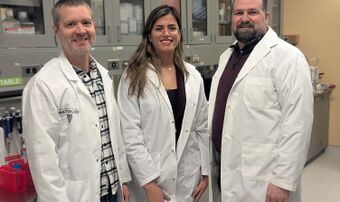
A research team led by the University of Waterloo is developing a novel tool to treat cancer by engineering hungry bacteria to literally eat tumours from the inside out.
“Bacteria spores enter the tumour, finding an environment where there are lots of nutrients and no oxygen, which this organism prefers, and so it starts eating those nutrients and growing in size,” said Dr. Marc Aucoin, a chemical engineering professor at Waterloo. “So, we are now colonizing that central space, and the bacterium is essentially ridding the body of the tumour.”
Key to the approach is a bacterium called Clostridium sporogenes, which is commonly found in soil and can only grow in environments with absolutely no oxygen. (More)
|
|