| Current News
|
- Chile became the first country in the Americas – and the second globally – to be officially verified by the WHO as having eliminated leprosy disease. (more)

- Canada and Australia signed new agreements on critical minerals, defence and security and AI during Canadian Prime Minister Mark Carney visit to Australia. (more)
 
- Australian hypersonic plane, called the DART AE, successfully completed first test flight at five times speed of sound. (more)
- Swiss President Guy Parmelin and the president of the European Commission, Ursula von der Leyen, signed a package of accords in Brussels. (more)

- Australian photographer Jono Allen won the top prize at the World Nature Photography Awards for his image of a rare white humpback whale calf and its mother. (more)
- A research team in Canada has engineered a tool to treat cancer by engineering hungry bacteriam to consume tumours from the inside out. (more)
- Researchers have identified the oldest known impressions of reptile skin ever recorded, preserved in rock from central Germany. (more)

- South African scientists have detected a record-breaking radio laser 8 billion light years away, offering new clues about how galaxies formed in the early universe. (more)

- Daniela Maier of Germany won the gold medal in women's skicross in a thrilling final at the Milano Cortina 2026 Winter Olympics. (more)
|
|
| D+ Editors' Picks
|
|
Beating cancer by eating cancer
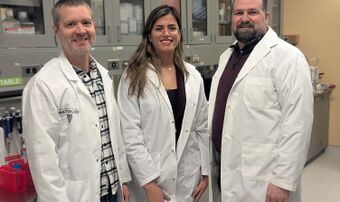
A research team led by the University of Waterloo is developing a novel tool to treat cancer by engineering hungry bacteria to literally eat tumours from the inside out.
“Bacteria spores enter the tumour, finding an environment where there are lots of nutrients and no oxygen, which this organism prefers, and so it starts eating those nutrients and growing in size,” said Dr. Marc Aucoin, a chemical engineering professor at Waterloo. “So, we are now colonizing that central space, and the bacterium is essentially ridding the body of the tumour.”
Key to the approach is a bacterium called Clostridium sporogenes, which is commonly found in soil and can only grow in environments with absolutely no oxygen. (More)
|
|