| Current News
|
- Chinese paleontologists have discovered a trove of well-preserved fossils from 518 million years ago on a bank of the Danshui River. (more)

- For the first time, a team of astronomers, including Professor Heino Falcke of the Netherlands, have managed to take a photo of a supermassive black hole. (more)

- Qatar-based media network Al Jazeera’s English news analysis program won the title of Broadcaster of the Year at the 2019 New York Festivals TV and Films Awards. (more)

- South Korea launched the world's first nationwide 5G mobile networks, which allows users to download entire movies almost instantaneously. (more)

- Dutchman Wiebe Wakker completed the world’s longest electric car journey after driving almost 60,000 miles from the Netherlands to Sydney. (more)
- A Peruvian team of palaeontologists has discovered a well-preserved skeleton of a four-legged whale ancestor in Playa Media Luna, in Peru's desert-like Pisco Basin. (more)

- Archaeologists in Egypt unveiled a well preserved and finely painted tomb, dating back more than 2,000 years. (more)

- Researchers in the United States have genetically modified mosquitoes to make humans less attractive to them. (more)

|
|
| D+ Editors' Picks
|
|
Researchers Developing Sensor to Detect Brain Disorders in Seconds
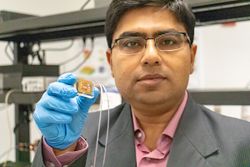
Using nanotechnology, UCF researchers have developed the first rapid detector for dopamine, a chemical that is believed to play a role in various diseases such as Parkinson’s, depression and some cancers.
Studies show too much dopamine could be associated with some cancers, while low dopamine could be associated with Parkinson’s disease and depression. The new technique developed at UCF requires only a few drops of blood, and results are available in minutes instead of hours because no separate lab is necessary to process the sample.
The new technology was described in a recent study in the journal Nano Letters. (More)
|
|